
Defining fish welfare and Operational Welfare Indicators (OWIs)
Fish welfare
Animal welfare is a complex and multifaceted topic, with many definitions and conceptual frameworks. Several widely recognized approaches include:
- Nature-based: Animal welfare is achieved when animals can express natural behaviors and use evolved adaptations in environments that meet their species’ behavioral and habitat needs.4
- Feeling-based: Animal welfare depends on subjective emotional experiences, requiring freedom from negative states (e.g., pain, fear) while enabling positive experiences (e.g., comfort, pleasure).5
- Function-based: Animal welfare is determined by proper biological functioning, including good health, normal growth and development, and the absence of disease, injury, or physiological dysfunction.6
- Coping-based: Animal welfare reflects an individual’s ability to cope with environmental challenges, where poor welfare occurs when adaptation mechanisms are overwhelmed or inadequate.7
- Affective balance: Animal welfare represents the cumulative balance of positive and negative experiences over time, where good welfare occurs when positive experiences outweigh negative ones.8
These frameworks are recognized as complementary rather than competing perspectives, and overlap in places: the affective balance approach is a variant of the feeling-based approach, and the coping-based view combines the function- and feeling-based approaches. Modern integrated approaches, such as the Five Domains Model,9 synthesize these perspectives by assessing welfare across multiple dimensions:
- Domain 1 (Nutrition): Adequate food and water.
- Domain 2 (Physical Environment): Appropriate thermal, atmospheric, and spatial conditions.
- Domain 3 (Health): Absence of disease, injury, and functional impairment.
- Domain 4 (Behavioral Interactions): Opportunities for species-typical behaviors, agency, and control.
- Domain 5 (Mental State): Overall affective experience integrating domains 1–4.
This multidimensional framework acknowledges that welfare encompasses biological functioning, behavioral expression, and subjective experience, with each domain contributing to the animal’s overall quality of life.
While acknowledging the complexity of the term ‘welfare’, this document adopts the definition used in the Laksvel protocol for Atlantic salmon: “quality of life as perceived by the fish itself.”10 This definition aligns with the feeling-based and affective balance perspectives by centering on the fish’s subjective experience. However, because subjective experience cannot be directly measured, this protocol uses observable indicators across multiple welfare domains as proxies for internal states.
The protocol’s indicators are organized to enable comprehensive assessment across these five welfare domains, acknowledging that no single indicator can capture the multifaceted nature of welfare.
Operational Welfare Indicators (OWIs)
Operational Welfare Indicators (OWIs) are standardized assessment tools designed for routine implementation in commercial aquaculture. Unlike some other proxy measures, such as plasma cortisol concentrations, that require laboratory analysis, OWIs enable practical on-farm assessment. These indicators are science-based, practically feasible, and provide actionable data for evidence-based management decisions.11
This document classifies OWIs into three categories:12
- Individual-based indicators (animal-based outcome measures): These assess the physical condition of individual fish (e.g., fin and skin condition) through sampling or camera-based observations. Individual-based indicators directly reflect how fish have been affected by their environment and management, providing outcome measures of their welfare state.
- Group-based indicators (outcome measures): These assess collective patterns at the population level, including behavior and mortality rates.
- Environmental indicators (input measures): These assess the aquatic environment, including dissolved oxygen and temperature. Environmental indicators represent the conditions fish experience and are critical determinants of welfare, though they are inputs rather than direct outcomes.
Operational Welfare Indicators are most useful when considering multiple indicators from different categories together. Together, they should be interpreted as contributing ‘welfare risk indicators,’ as no indicator can describe the internal welfare state of an animal, but will influence the likelihood of welfare compromise.
Relationship between OWI categories and welfare domains
The table below shows how the three OWI categories address the Five Domains of welfare:
| Welfare domain | Individual-based indicators | Group-based indicators | Environmental indicators |
|---|---|---|---|
| 1. Nutrition | Emaciation | Feeding behavior | N/A |
| 2. Physical environment | Morphological damage related to the environment | Swimming behavior, mortality (e.g., due to poor water quality) | Water quality, stocking density |
| 3. Health | Morphological damage, including that related to disease signs, deformities | Mortality, disease (not in current protocol) | Water quality (disease risk factors) |
| 4. Behavioral interactions | Morphological damage from aggression (particularly fin damage) | Aberrant behavior, aggressive behavior, feeding behavior, and swimming behavior | Stocking density, water flow/velocity |
| 5. Mental state | Pain and other negative affective states inferred from assessment of all individual-based indicators | Mental discomfort inferred from all group-based indicators | Mental discomfort inferred from all environmental indicators |
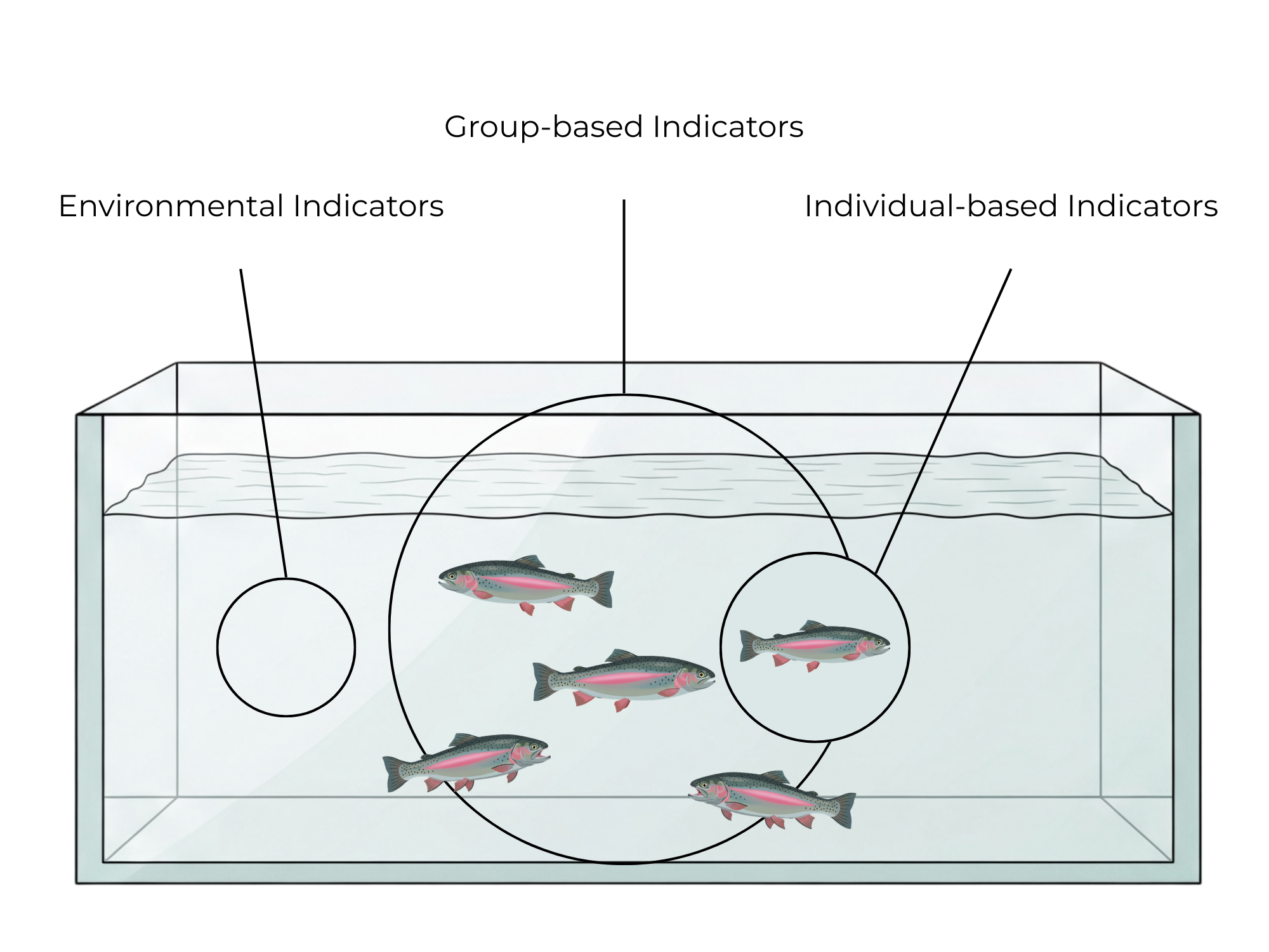
Schematic representation of environmental, group-based, and individual-based indicators. Illustration created by the Centre for Aquaculture Progress.
-
Fraser, D., D. M. Weary, E. A. Pajor, and B. N. Milligan. “A Scientific Conception of Animal Welfare That Reflects Ethical Concerns.” Animal Welfare 6, no. 3 (August 1997): 187–205. https://doi.org/10.1017/s0962728600019795.
-
Fraser, D., D. M. Weary, E. A. Pajor, and B. N. Milligan. “A Scientific Conception of Animal Welfare That Reflects Ethical Concerns.” Animal Welfare 6, no. 3 (August 1997): 187–205. https://doi.org/10.1017/s0962728600019795.
-
Fraser, D., D. M. Weary, E. A. Pajor, and B. N. Milligan. “A Scientific Conception of Animal Welfare That Reflects Ethical Concerns.” Animal Welfare 6, no. 3 (August 1997): 187–205. https://doi.org/10.1017/s0962728600019795.
-
Broom, D. M. “Animal Welfare: Concepts and Measurement.” Journal of Animal Science 69, no. 10 (October 1, 1991): 4167–75. https://doi.org/10.2527/1991.69104167x.
-
Reimert, I., L. E. Webb, M. A. van Marwijk, and J. E. Bolhuis. “Review: Towards an Integrated Concept of Animal Welfare.” Animal 17, no. 4 (August 2023). https://doi.org/10.1016/j.animal.2023.100838.
-
Mellor, David J., Ngaio J. Beausoleil, Katherine E. Littlewood, Andrew N. McLean, Paul D. McGreevy, Bidda Jones, and Cristina Wilkins. “The 2020 Five Domains Model: Including Human–Animal Interactions in Assessments of Animal Welfare.” Animals 10, no. 10 (October 14, 2020): 1870. https://doi.org/10.3390/ani10101870.
-
Nilsson, Jonatan, Kristine Gismervik, Kristoffer Vale Nielsen, Martin Haugsmo Iversen, Chris Noble, Jelena Kolarevic, Hilde Frotjold, et al. 2025. “Laksvel — a Standardised, Operational Welfare Monitoring Protocol for Atlantic Salmon Held in Sea Cages.” Institute of Marine Research. https://www.hi.no/en/hi/nettrapporter/rapport-fra-havforskningen-en-2025-40.
-
Martins, Catarina I. M., Leonor Galhardo, Chris Noble, Børge Damsgård, Maria T. Spedicato, Walter Zupa, Marilyn Beauchaud, et al. “Behavioural Indicators of Welfare in Farmed Fish.” Fish Physiology and Biochemistry 38, no. 1 (July 28, 2011): 17–41. https://doi.org/10.1007/s10695-011-9518-8.
-
Nilsson, Jonatan, Kristine Gismervik, Kristoffer Vale Nielsen, Martin Haugsmo Iversen, Chris Noble, Jelena Kolarevic, Hilde Frotjold, et al. 2025. “Laksvel — a Standardised, Operational Welfare Monitoring Protocol for Atlantic Salmon Held in Sea Cages.” Institute of Marine Research. https://www.hi.no/en/hi/nettrapporter/rapport-fra-havforskningen-en-2025-40.