
Vertebral deformity
A well-formed spine is needed for efficient swimming, maintaining body position, and normal biological function. Deformity prevalence is a valuable indicator of prior and ongoing management practices, as deformities can arise from genetic factors, nutritional deficiencies, environmental stressors, or inappropriate rearing conditions. As deformities tend to arise from these developmental problems, they reflect longer-term, rather than acute, welfare issues. Deformities, including vertebral abnormalities, compromise essential biological functions and cause ongoing stress.
| Level 0 | Level 1 | Level 2 | Level 3 |
|---|---|---|---|
|
No visible vertebral deformity |
Minor or suspected vertebral deformity, notable only with close inspection or running a hand over the fish |
Clear vertebral deformity causing no functional deviation or injuries |
Severe vertebral deformity causing functional deviation or injuries |
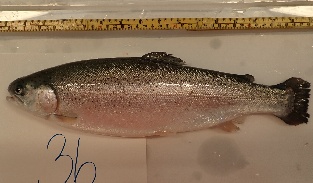
Healthy rainbow trout with no externally visible vertebral deformity81
|
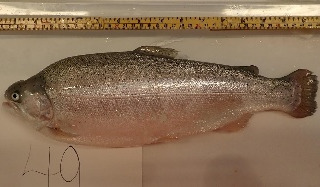
Rainbow trout with minor vertebral deformity82
|
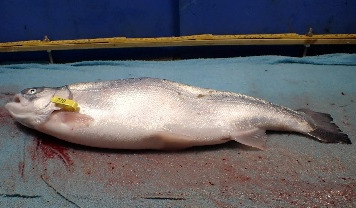
Rainbow trout with clear vertebral deformity83
|
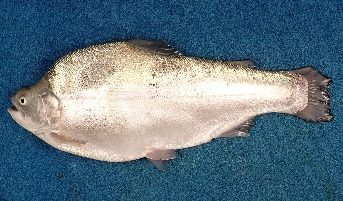
Rainbow trout with severe vertebral deformity84
|
Protocol application
Assessment requires handling the fish out of water. The fish should be viewed in profile and from above to evaluate the dorsal line for irregularities, subtle deviations, or kinks. Running a hand along the spine can help detect minor deformities not visible to the eye.
Calculate the distribution of scores across the thresholds within the sample.
Scoring notes
- A fish with a straight dorsal profile and smooth body curvature is recorded as level 0.
- A minor vertebral deformity (level 1) does not have any clear, visible kinks, but will show some subtle irregularities or deviations.
- A level 2 vertebral deformity will include clear, visible deviations.
- A severe deformity (level 3) will include visible kinks or clear deviations or curves. The fish’s swimming will likely be impacted.
- Vertebral deformities are chronic conditions and are not expected to improve over time.
- Studies show that many vertebral deformities are not visible externally. Due to the nature of OWIs, this protocol only enables assessment of externally visible deformities. This may underestimate the total prevalence of deformity, but it identifies fish with more severe welfare impacts.
- Validation: This scoring system has been adapted from the Laksvel scoring system for Atlantic salmon.
Key evidence
| Source | Summary of source | Key result |
|---|---|---|
| Fjelldal et al., 2025 | Experimental study investigating the progression of vertebral deformities and growth in 12000 female rainbow trout as they grew from 36 g to 5.5 kg in laboratory conditions over one year. Fish were initially raised in freshwater tanks and then transferred to sea cages. Between 80 and 100 fish were sampled at 4 different sampling points. Other validation groups were also assessed (different strains or fish raised in various conditions). Note: Deformities were detected using X-ray imaging, which identified internal vertebral deformities not visible by external inspection. |
There was a dramatic increase in deformities, from 20% in fish at 36 g to 93% in fish at 5.5 kg. The average number of deformed vertebrae per affected fish also increased, from 4 to 12. Deformity severity was strongly negatively correlated with fish length and weight. Tail deformities correlated with caudal fin degradation, with the authors suggesting a bidirectional relationship. All validation groups showed a 74–83% deformity rate. |
| Davidson et al., 2011 | Two experimental studies investigating the impacts of different freshwater RAS conditions on rainbow trout health and welfare. Experiment 1 compared very low water exchange and high water exchange in rainbow trout (151 g) over six months. Experiment 2 compared low water exchange to near-zero water exchange in rainbow trout (18 g). |
Skeletal deformities increased substantially in near-zero exchange systems, reaching 38% in the most restricted system, compared with 0% in higher-exchange systems. Increased deformities correlated with increased mortality, but causation was not established. Poor water quality may have caused both increased deformities and mortality. |
| Aunsmo et al., 2008 | Experimental study investigating how clinically scored vertebral deformity relates to growth and carcass downgrading in ongrowing Atlantic salmon raised in commercial environments, using a visual scale from 0–3 at slaughter. | Outcomes were not separated by score, so the results refer to all fish scoring between 1 and 3. All fish with vertebral deformity scores above 0 were downgraded from superior production quality, demonstrating the negative economic impact of detectable deformities. Deformed fish had a mean slaughter weight of approximately 2.8 kg (about 62% of the mean slaughter weight of 4.5 kg for superior-grade fish), indicating a significant and sustained growth deficit associated with visible deformities. Radiography showed compressed or fused vertebrae, mainly in the tail, and in approximately one-third of cases extending cranially. Increasing severity of vaccine-related adhesions and abdominal melanization increased the odds of spinal deformity, suggesting fish with severe internal lesions and deformity experience combined burdens of chronic pathology and reduced growth. |
Supporting evidence
- Aunsmo, A., A. Guttvik, P. J. Midtlyng, R. B. Larssen, Ø. Evensen, and E. Skjerve. “Association of Spinal Deformity and Vaccine-Induced Abdominal Lesions in Harvest-Sized Atlantic Salmon, Salmo salar L.” Journal of Fish Diseases 31, no. 7 (June 28, 2008): 515–24. https://doi.org/10.1111/j.1365-2761.2007.00899.x.
- Davidson, John, Christopher Good, Carla Welsh, and Steven T. Summerfelt. “Abnormal Swimming Behavior and Increased Deformities in Rainbow Trout Oncorhynchus mykiss Cultured in Low Exchange Water Recirculating Aquaculture Systems.” Aquacultural Engineering 45, no. 3 (November 2011): 109–17. https://doi.org/10.1016/j.aquaeng.2011.08.005.
- Fjelldal, Per Gunnar, Sankar Murugesan, Tone Vågseth, Audun Østby Pedersen, Angelico Madaro, Samantha Bui, Harald Kryvi, Lars Helge Stien, and Jonatan Nilsson. “Vertebral Deformities in Cultured Big Size Rainbow Trout: Radiological Analysis from Juvenile to Harvest Size.” Aquaculture 596 (2025): 741729. https://doi.org/10.1016/j.aquaculture.2024.741729.
- Nilsson, Jonatan, Kristine Gismervik, Kristoffer Vale Nielsen, Martin Haugsmo Iversen, Chris Noble, Jelena Kolarevic, Hilde Frotjold, et al. 2025. “Laksvel — a Standardised, Operational Welfare Monitoring Protocol for Atlantic Salmon Held in Sea Cages.” Institute of Marine Research. https://www.hi.no/en/hi/nettrapporter/rapport-fra-havforskningen-en-2025-40.
- Noble, C., K. Gismervik, M. H. Iversen, J. Kolarevic, J. Nilsson, L. H. Stien, and J. F. Turnbull. 2020. “Welfare Indicators for Farmed Rainbow Trout: Tools for Assessing Fish Welfare.” Nofima. https://nofima.no/wp-content/uploads/2020/05/Welfare-Indicators-for-farmed-rainbow-trout-Noble-et-al.-2020.pdf.
- Özcan, Filiz. “Prevalence and Causes of Skeletal Deformities in Cultured Juvenile Oncorhynchus mykiss. Skeletal Deformities in Cultured Juvenile Oncorhynchus mykiss.” Revista Colombiana de Ciencias Pecuarias 38 (2025). https://doi.org/10.17533/udea.rccp.e359311.
- Powell, Mark D., Matthew A. Jones, and Maite Lijalad. “Effects of Skeletal Deformities on Swimming Performance and Recovery from Exhaustive Exercise in Triploid Atlantic Salmon.” Diseases of Aquatic Organisms 85 (May 27, 2009): 59–66. https://doi.org/10.3354/dao02056.
- Witten, P. Eckhard, Laura Gil-Martens, Ann Huysseune, Harald Takle, and Kirsti Hjelde. “Towards a Classification and an Understanding of Developmental Relationships of Vertebral Body Malformations in Atlantic Salmon (Salmo salar L.).” Aquaculture 295, no. 1-2 (October 2009): 6–14. https://doi.org/10.1016/j.aquaculture.2009.06.037.
-
Nilsson, Jonatan. 2026. Vertebral deformity in rainbow trout, score 0. Photograph. Personal communication, Institute of Marine Research.
-
Nilsson, Jonatan. 2026. Vertebral deformity in rainbow trout, score 1. Photograph. Personal communication, Institute of Marine Research.
-
Nilsson, Jonatan. 2026. Vertebral deformity in rainbow trout, score 2. Photograph. Personal communication, Institute of Marine Research.
-
Nilsson, Jonatan. 2026. Vertebral deformity in rainbow trout, score 3. Photograph. Personal communication, Institute of Marine Research.