
Body condition
Condition factor measures the relationship between a fish’s weight and length. A healthy condition factor reflects adequate energy reserves and that a fish is feeding and growing well. Poor condition factor (appearing thin or emaciated) can indicate inadequate nutrition, poor feed management, chronic stress, disease, or suboptimal environmental conditions that impair growth and energy storage. It is a lagging indicator of welfare and can indicate sustained welfare compromise.
Condition factor
| Level 0 | Level 1 | Level 2 | Level 3 |
|---|---|---|---|
|
> 1.4
|
> 1.2 to ≤ 1.4
|
> 1 to ≤ 1.2
|
≤ 1
|
Emaciation
| Level 0 | Level 1 | Level 2 | Level 3 |
|---|---|---|---|
|
No signs of emaciation |
Slightly lean |
Clearly emaciated |
Severely emaciated |
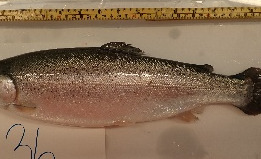
Healthy rainbow trout with condition factor 1.4785
|
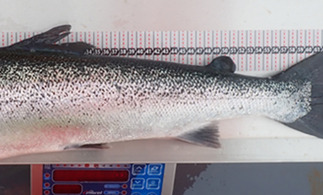
Slightly lean Atlantic salmon with condition factor 1–1.286
|
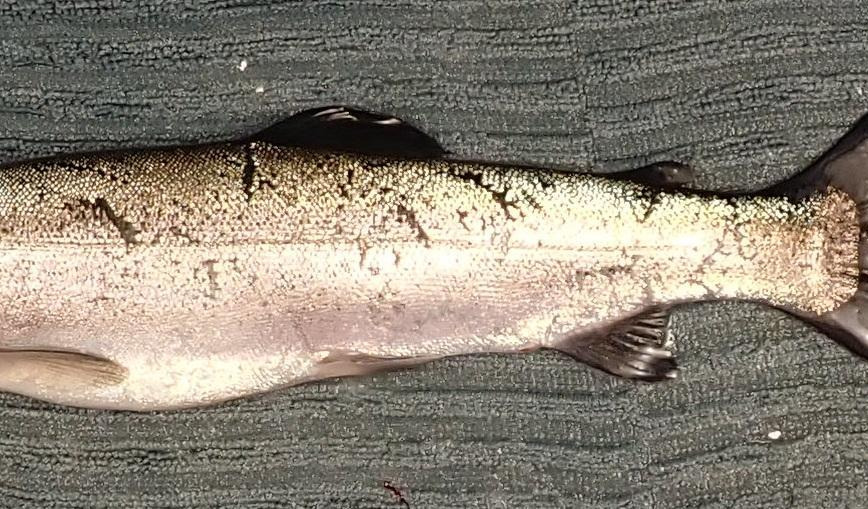
Clearly emaciated rainbow trout with condition factor 1.0187
|
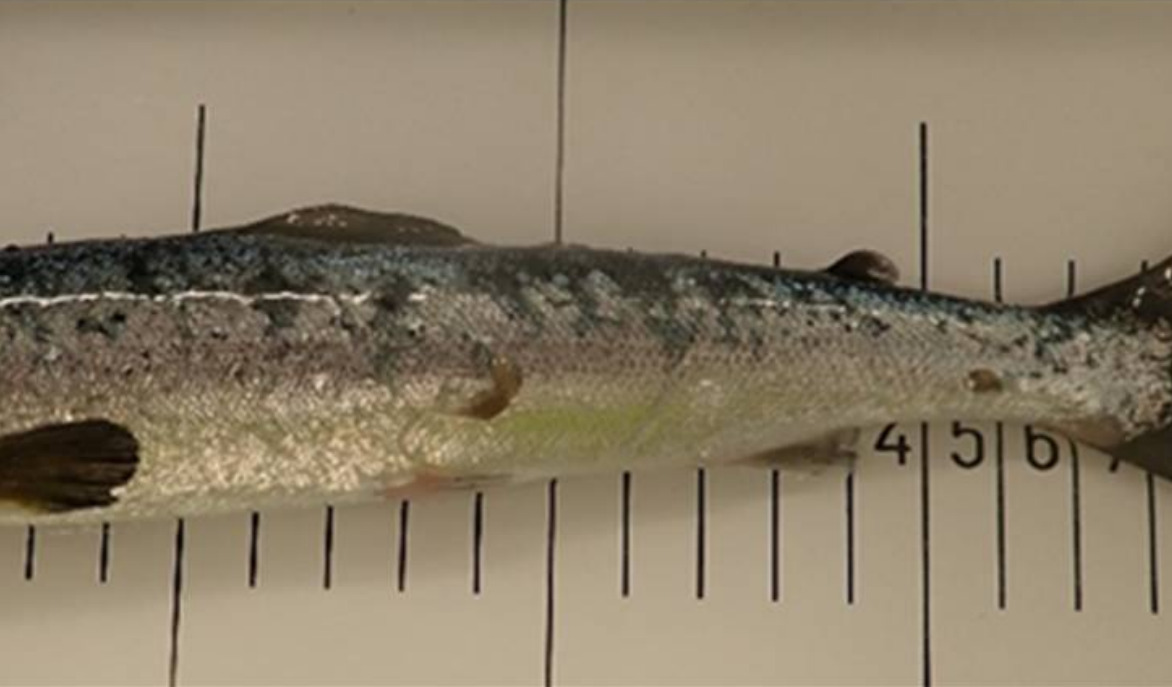
Severely emaciated Atlantic salmon88
|
Overall: Overall score is determined by the most severe subindicator
Protocol application
Assessment requires handling the fish out of water. If weighing and measuring individual fish is practical, use the condition factor scoring system. Whether the condition factor is measured or not, always conduct a visual assessment.
Condition factor (often denoted as ‘K’) is calculated as follows: K = 100 × W / L³, where W is the total body weight of the individual fish (g), and L is the fork length (cm).
In most cases, the condition factor will align with the fish’s visual appearance. Where they do not match, visual assessment will take priority for scoring. For example, a fish might be calculated to have a level 0 K value of above 1.4 but still appear emaciated due to body shortening or deformity. In such cases, score the fish according to its visual category.
Scoring notes
- Decreasing condition factor over time is a sign of poor welfare, even if in absolute terms the condition factor remains in the level 0 or level 1 range. For example, a decrease in condition factor from 1.3 to 1.1 is a warning sign.
- Signs of emaciation include visible spine or ribs and reduced muscle mass.
- Very high condition factors may indicate deformity (e.g., when a spinal deformity has compressed the body length) or obesity and should be investigated, but are not scored as a welfare concern under this indicator. There is limited available data on how fish welfare is affected when fish reach extremely high body weights.
- Comparing the body condition of individual fish to their cohort can be a useful indicator when scoring. However, if the entire population is in poor condition, comparison to conspecifics alone may not identify the problem.
- Validation: The condition factor thresholds are based on the studies set out below. These mostly involved smaller freshwater rainbow trout, which tend to have lower condition factors than larger seawater rainbow trout. Further, it was not always clear how the condition factor was being measured (for example, whether the fork length or standard length was being used), meaning the results may not have been measured consistently. As rainbow trout grow out in seawater, their condition factor also increases. Based on expert opinion and the distribution of condition factors in Fjelldal et al. (2025), the condition factor thresholds for freshwater rainbow trout were adjusted up by 0.2 to account for seawater rainbow trout. The visual scoring system has been adapted from the Laksvel scoring system for Atlantic salmon.
Key evidence
| Source | Summary of source | Key result |
|---|---|---|
| MacIntyre, 2008 | Large-scale survey investigating welfare in rainbow trout conducted across 44 freshwater rainbow trout farms in the British Isles from July 2005 to April 2007. Each farm was visited twice, with up to four different systems (cages, ponds, raceways, tanks) sampled per visit. Both small (< 100 g) and large (> 100 g) fish were sampled, with 12 or 24 fish taken from each system, totaling 3699 fish sampled from 189 systems. |
Condition factor ranged from 0.84 to 2.20, with a mean of 1.31. The author considered this mean condition factor to be within the normal, healthy range. Increasing condition factor was associated with improved welfare up to 1.3, after which improvements plateaued, and large deviations were associated with worse welfare. Condition factors below 1.0 were associated with increased cortisol. |
| Pottinger et al., 2003 | Experimental study investigating biomarkers associated with fasting in 900 two-year-old ongrowing rainbow trout (282 g) in freshwater laboratory conditions over 17 weeks. Fish were divided into three groups: continuously fed (control), fasted and then refed (fasted for 9 weeks then fed for the remainder of the study period), and continuously fasted (fasted for the entire 17 weeks). At various intervals, 10 fish per tank were sampled. |
Both fasted groups showed rapid, significant declines in body weight and condition factor. Refed fish quickly recovered weight and condition factor after feeding resumed, becoming indistinguishable from the control by the end of the study. Fasting did not consistently elevate cortisol levels. The baseline condition factor for the unfasted group was approximately 1.2. When fasted fish reached a condition factor of < 1.1 at week 11, growth hormone rose extremely high, and somatolactin levels showed clear, significant differences, with persistently high free fatty acids. After week 11, the level of free fatty acids dropped, indicating severe starvation. |
| Salem et al., 2007 | Experimental study investigating the effect of starvation on global gene expression in 12 ongrowing rainbow trout (193 g) in laboratory conditions over 3 weeks. The control group was continuously fed. |
Starved fish lost significant weight (172 g vs. 280 g in fed fish). In starved fish, 202 genes were down-regulated, compared with 27 up-regulated, indicating that the fish were entering a critical survival mode. |
| Gao, 2024 | Fact sheet discussing the importance of measuring and calculating condition factor in farmed salmonid species. | Emaciation was defined as a condition factor < 0.9, while positive performance was defined as a condition factor > 1.1, and possible deformity was defined as > 1.6. |
Supporting evidence
- Barnham, Charles, and Alan Baxter. “Condition Factor, K, for Salmonid Fish.” State of Victoria, Department of Primary Industries, March 1998.
- Dürrani, Ömerhan. “Do the Length-Weight Relationships and Condition Factors of Farmed Rainbow Trout, Brook, and Brown Trout Differ from Their Wild Counterparts?” Aquatic Research 6, no. 4 (2023): 253–59. https://doi.org/10.3153/ar23024.
- Fjelldal, Per Gunnar, Sankar Murugesan, Tone Vågseth, Audun Østby Pedersen, Angelico Madaro, Samantha Bui, Harald Kryvi, Lars Helge Stien, and Jonatan Nilsson. “Vertebral Deformities in Cultured Big Size Rainbow Trout: Radiological Analysis from Juvenile to Harvest Size.” Aquaculture 596, no. Part 1 (2025): 741729. https://doi.org/10.1016/j.aquaculture.2024.741729.
- Furné, M., M. García-Gallego, M. C. Hidalgo, A. E. Morales, A. Domezain, J. Domezain, and A. Sanz. “Oxidative Stress Parameters during Starvation and Refeeding Periods in Adriatic Sturgeon (Acipenser Naccarii) and Rainbow Trout (Oncorhynchus mykiss).” Aquaculture Nutrition 15, no. 6 (November 28, 2008): 587–95. https://doi.org/10.1111/j.1365-2095.2008.00626.x.
- Gao, N. “Condition Factor for Salmonid Aquaculture.” Ministry of Agriculture, Food and Agribusiness, October 2024. https://www.ontario.ca/files/2024-11/omafa-condition-factor-for-salmonids-en-2024-11-26.pdf.
- MacIntyre, Craig. “Water Quality and Welfare Assessment on United Kingdom Trout Farms.” PhD Thesis, 2008. https://dspace.stir.ac.uk/bitstream/1893/434/1/FINAL%20THESIS.pdf.
- Noble, C., K. Gismervik, M. H. Iversen, J. Kolarevic, J. Nilsson, L. H. Stien, and J. F. Turnbull. 2020. “Welfare Indicators for Farmed Rainbow Trout: Tools for Assessing Fish Welfare.” Nofima. https://nofima.no/wp-content/uploads/2020/05/Welfare-Indicators-for-farmed-rainbow-trout-Noble-et-al.-2020.pdf.
- North, B. P., J. F. Turnbull, T. Ellis, M. J. Porter, H. Migaud, J. Bron, and N. R. Bromage. “The Impact of Stocking Density on the Welfare of Rainbow Trout (Oncorhynchus mykiss).” Aquaculture 255, no. 1-4 (May 2006): 466–79. https://doi.org/10.1016/j.aquaculture.2006.01.004.
- Pottinger, T. G., M. Rand-Weaver, and J. P. Sumpter. “Overwinter Fasting and Re-Feeding in Rainbow Trout: Plasma Growth Hormone and Cortisol Levels in Relation to Energy Mobilisation.” Comparative Biochemistry and Physiology Part B: Biochemistry and Molecular Biology 136, no. 3 (November 2003): 403–17. https://doi.org/10.1016/s1096-4959(03)00212-4.
- Salem, Mohamed, Jeff Silverstein, Caird E. Rexroad, and Jianbo Yao. “Effect of Starvation on Global Gene Expression and Proteolysis in Rainbow Trout (Oncorhynchus mykiss).” BMC Genomics 8, no. 1 (September 19, 2007). https://doi.org/10.1186/1471-2164-8-328.
- Sumpter, J. P., P. Y. Le Bail, A. D. Pickering, T. G. Pottinger, and J. F. Carragher. “The Effect of Starvation on Growth and Plasma Growth Hormone Concentrations of Rainbow Trout, Oncorhynchus mykiss.” General and Comparative Endocrinology 83, no. 1 (July 1991): 94–102. https://doi.org/10.1016/0016-6480(91)90109-j.
-
Nilsson, Jonatan. 2026. Healthy rainbow trout, body condition score 0. Photograph. Personal communication, Institute of Marine Research.
-
Nilsson, Jonatan, Kristine Gismervik, Kristoffer Vale Nielsen, Martin Haugsmo Iversen, Chris Noble, Jelena Kolarevic, Hilde Frotjold, et al. 2025. “Laksvel — a Standardised, Operational Welfare Monitoring Protocol for Atlantic Salmon Held in Sea Cages.” Institute of Marine Research. https://www.hi.no/en/hi/nettrapporter/rapport-fra-havforskningen-en-2025-40.
-
Nilsson, Jonatan. 2026. Clearly emaciated rainbow trout, body condition score 2. Photograph. Personal communication, Institute of Marine Research.
-
Nilsson, Jonatan, Kristine Gismervik, Kristoffer Vale Nielsen, Martin Haugsmo Iversen, Chris Noble, Jelena Kolarevic, Hilde Frotjold, et al. 2025. “Laksvel — a Standardised, Operational Welfare Monitoring Protocol for Atlantic Salmon Held in Sea Cages.” Institute of Marine Research. https://www.hi.no/en/hi/nettrapporter/rapport-fra-havforskningen-en-2025-40.