
Snout damage
The snout and mouth of fish are essential for feeding, respiration through the buccal-opercular pump, buoyancy regulation, and maintaining water flow over the gills. Snout injuries may result from collisions, handling, aggressive interactions, or infections, and can act as chronic stressors that impair performance and suppress immune function. In severe cases, wounds may become infected with bacteria such as Tenacibaculum maritimum, leading to “mouth rot,” a condition associated with rapid tissue deterioration and increased mortality risk. Snout wounds also increase metabolic costs related to tissue repair and osmoregulatory disturbance, while pain, impaired jaw movement, and reduced feeding ability may negatively affect growth, swimming performance, and recovery capacity. Damage severity likely determines functional impact, although this remains poorly validated. Snout injuries should also be distinguished from jaw deformities.
| Level 0 | Level 1 | Level 2 | Level 3 |
|---|---|---|---|
|
No visible snout damage |
Minor snout damage (no open wounds) |
Clear snout damage covering a large area |
Severe snout damage |
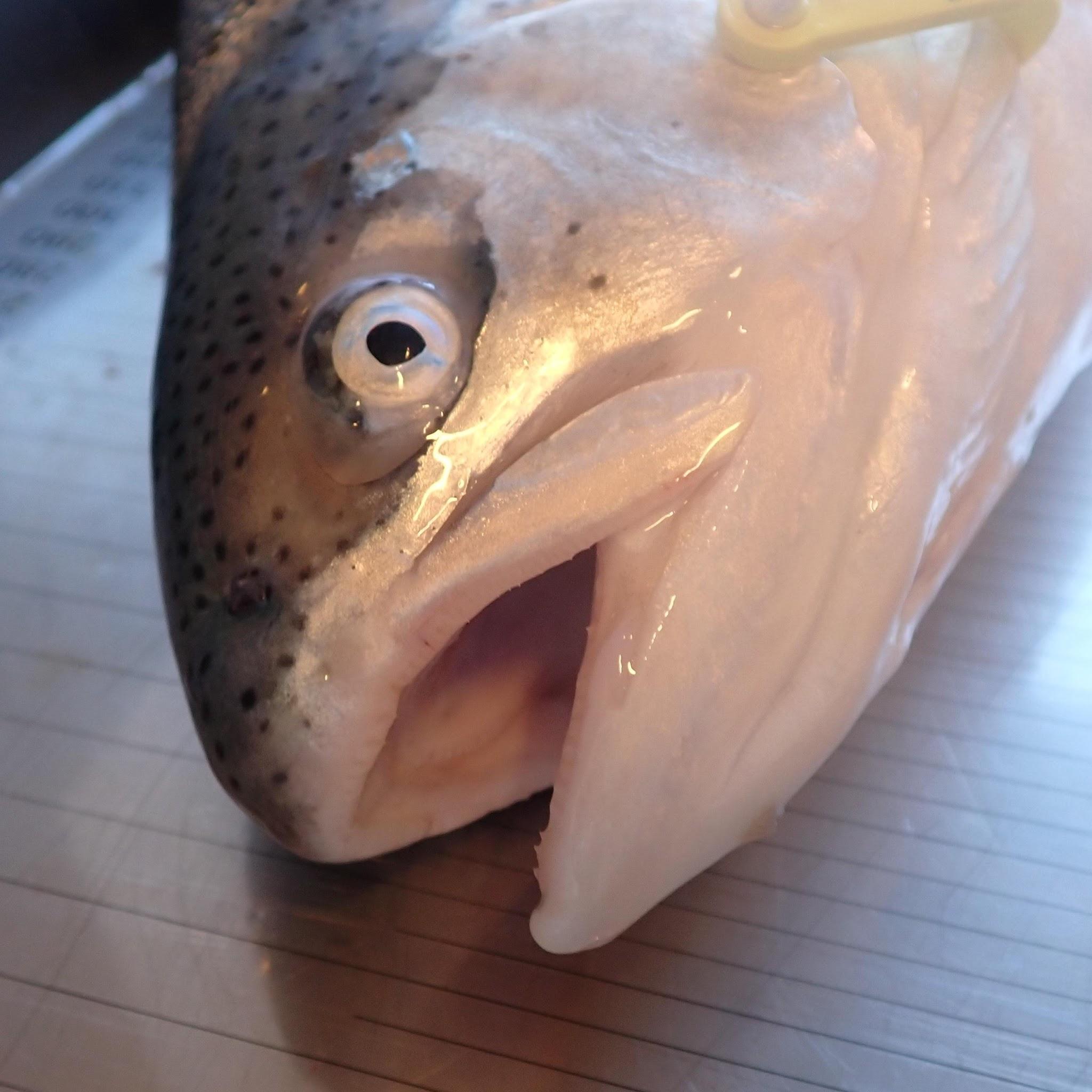
Rainbow trout with no snout damage101
|
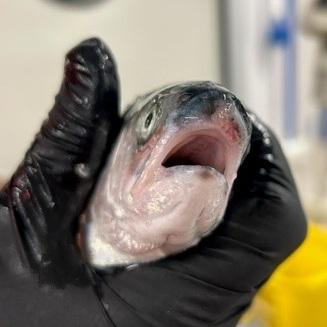
Rainbow trout with minor snout damage102
|
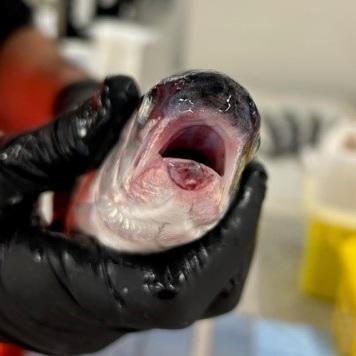
Rainbow trout with clear snout damage43
|
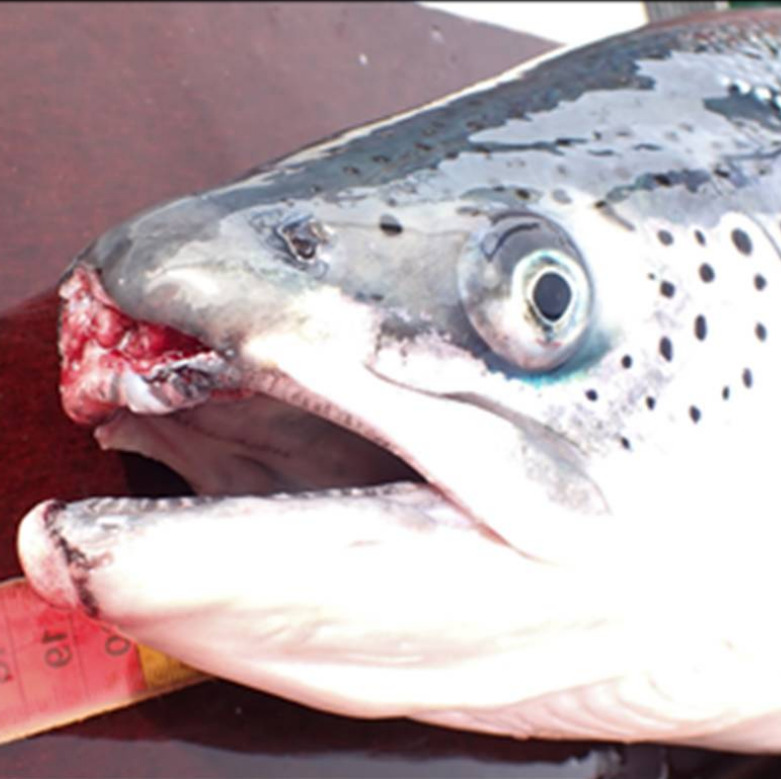
Atlantic salmon with severe snout damage44
|
Protocol application
Assessment requires handling the fish for close inspection of the snout and mouth area.
Injuries to the jaw that do not include the tip of the jaw should be recorded under skin hemorrhaging or wounds.
Calculate the distribution of scores across the thresholds within the sample.
Scoring notes
- The status of injuries (fresh, healed, or infected) is critical to assess because fresh tissue damage is automatically more severe.
- Fresh damage may have active bleeding, red or pink inflamed spots, potential swelling or edema, and may indicate recent trauma.
- Healed damage will have a stable size with scar tissue formed and no active bleeding, indicating the welfare issue has been largely resolved.
- Infected wounds can have white or grey fungal growth and excessive debris or mucus.
- Minor snout damage includes surface abrasions that affect only the epidermis or superficial dermis, with no exposed cartilage or bone, and no active bleeding.
- Clear snout damage includes any damage with any exposure of cartilage or bone, with active bleeding, tissue loss creating a depression in the snout profile, or signs of infection. Signs of infection include any white or grey fungal growth, or excessive debris or mucus, visible discharge, redness extending substantially from the wound edge, or necrotic tissue.
- Note whether the damage is bilateral (affecting both the upper and lower jaws) and the specific location (e.g., tip damage could impair precision feeding, rostral damage could affect the mouth opening or closing). Where the damage is bilateral, monitoring should be increased, and this may warrant preventative action.
- Validation: This scoring system has been adapted from the Laksvel scoring system for Atlantic salmon.
Key evidence
| Source | Summary of source | Key result |
|---|---|---|
| Sneddon, 2003 | Experimental study investigating behavioral and physiological responses consistent with pain perception in 25 rainbow trout (~61 g) in freshwater laboratory conditions. There were 5 treatment groups: control (only handled), saline-injected, acid-injected, acid- and morphine-injected, and morphine-injected. The injection was in the trout’s lips. |
Acid-injected fish rested on the substrate and rocked from side to side on their pectoral fins. The authors interpreted this as possible stereotypic or comfort-seeking behavior. Fish also rubbed their lips against gravel or tank walls, which the authors interpreted as an attempt to relieve pain. These behaviors were nearly absent in controls and were significantly reduced by morphine. |
| Moltumyr et al., 2022 | Experimental study investigating external injury outcomes after two warm water exposures in 332 seawater-acclimated Atlantic salmon post-smolts (1380 g). Treatments were conducted at approximately 34°C (and 9°C for the control) for 30 seconds, administered twice, with 23–24 days between administrations. For the treatment, fish were dip-netted and placed in a plastic chamber for 30 seconds. Various external injuries were scored from 0 to 3 (increasing in severity). Final scoring was conducted 17–18 days after the second exposure. |
Fish in the warm water group displayed vigorous behavior, frantically trying to escape. Some fish displayed such vigorous escape behavior that they fainted after colliding with the walls. The fish in the control group behaved more calmly. Compared to the control group, treated fish showed a higher prevalence of scores 2 and 3 for scale loss, snout wounds, eye problems, and active fin injuries. The baseline prevalence for scale loss scores between 1 and 3 was very high for both the control and treatment groups, at 99–100%. The baseline prevalence for skin bleeding scores between 1 and 3 was 73–79%. Snout wounds had a prevalence of 7–12% before the treatment. At the end of the experiment, the prevalence was 99%, and wound severity was significantly higher in the warm water group. |
| Stien et al. (2025) | Review of injury-based welfare indicators of farmed salmon in the Laksvel protocol. | Snout wounds can affect either the upper or lower jaw, and do not need to be restricted only to the tip of the snout. When salmon are transported (e.g., through pumps or delousing systems), they move headfirst, increasing the risk of snout collision into equipment or other fish. Snout wounds can become infected, e.g., leading to mouth rot or yellow mouth. |
Supporting evidence
- Moltumyr, Lene, Jonatan Nilsson, Angelico Madaro, Tore Seternes, Fredrik Agerup Winger, Ivar Rønnestad, and Lars Helge Stien. “Long-Term Welfare Effects of Repeated Warm Water Treatments on Atlantic Salmon (Salmo salar).” Aquaculture 548 (February 15, 2022): 737670. https://doi.org/10.1016/j.aquaculture.2021.737670.
- Nilsson, Jonatan, Kristine Gismervik, Kristoffer Vale Nielsen, Martin Haugsmo Iversen, Chris Noble, Jelena Kolarevic, Hilde Frotjold, et al. 2025. “Laksvel — a Standardised, Operational Welfare Monitoring Protocol for Atlantic Salmon Held in Sea Cages.” Institute of Marine Research. https://www.hi.no/en/hi/nettrapporter/rapport-fra-havforskningen-en-2025-40.
- Noble, C., K. Gismervik, M. H. Iversen, J. Kolarevic, J. Nilsson, L. H. Stien, and J. F. Turnbull. 2020. “Welfare Indicators for Farmed Rainbow Trout: Tools for Assessing Fish Welfare.” Nofima. https://nofima.no/wp-content/uploads/2020/05/Welfare-Indicators-for-farmed-rainbow-trout-Noble-et-al.-2020.pdf.
- Noble, Chris, Hernán A. Cañon Jones, Børge Damsgård, Matthew J. Flood, Kjell Ø. Midling, Ana Roque, Bjørn-Steinar Sæther, and Stephanie Yue Cottee. “Injuries and Deformities in Fish: Their Potential Impacts upon Aquacultural Production and Welfare.” Fish Physiology and Biochemistry 38, no. 1 (September 15, 2011): 61–83. https://doi.org/10.1007/s10695-011-9557-1.
- Sneddon, Lynne U. “The Evidence for Pain in Fish: The Use of Morphine as an Analgesic.” Applied Animal Behaviour Science 83, no. 2 (September 2003): 153–62. https://doi.org/10.1016/s0168-1591(03)00113-8.
- Stien, Lars Helge, Chris Noble, Angelico Madaro, Jonatan Nilsson, René Alvestad, Kristine Gismervik, Ewa Harasimczuk, Hogne Bleie, Karoline Skaar Amthor, and Marc B. M. Bracke. “Reviewing the Severity of Handling-Induced Injuries in the LAKSVEL Protocol for Salmon Welfare.” Reviews in Aquaculture 17, no. 4 (August 14, 2025). https://doi.org/10.1111/raq.70076.
-
Bui, Samantha. 2026. Snout damage in rainbow trout, score 2. Photograph. Personal communication, Institute of Marine Research.
-
Nilsson, Jonatan, Kristine Gismervik, Kristoffer Vale Nielsen, Martin Haugsmo Iversen, Chris Noble, Jelena Kolarevic, Hilde Frotjold, et al. 2025. “Laksvel — a Standardised, Operational Welfare Monitoring Protocol for Atlantic Salmon Held in Sea Cages.” Institute of Marine Research. https://www.hi.no/en/hi/nettrapporter/rapport-fra-havforskningen-en-2025-40.
-
Nilsson, Jonatan. 2026. Snout damage in rainbow trout, score 0. Photograph. Personal communication, Institute of Marine Research.
-
Bui, Samantha. 2026. Snout damage in rainbow trout, score 1. Photograph. Personal communication, Institute of Marine Research.