
Eye injury
Undamaged eyes are essential for vision, enabling fish to feed, navigate their environment, and respond to threats or social cues. The eyes of farmed fish are sensitive, and injuries can occur from physical trauma (e.g., handling, crowding, or contact with equipment), poor water quality, disease, parasites, or gas supersaturation (which can rupture blood vessels). Clinical signs of eye injury include bleeding and exophthalmos (protrusion of the eye). Like eye opacity, eye injuries can reduce visual capacity, compromising a fish’s ability to navigate its environment properly. This can lead to increased behavioral and physiological stress.
| Level 0 | Level 1 | Level 2 | Level 3 |
|---|---|---|---|
|
No visible eye injury |
Minor eye injury, visible only with close inspection |
Clear eye injury with low likelihood of blindness |
Severe eye injury with high likelihood of blindness |
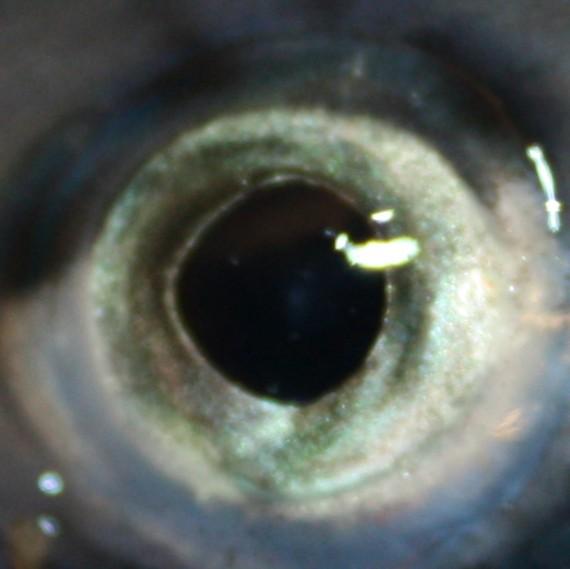
Healthy rainbow trout eye53
|
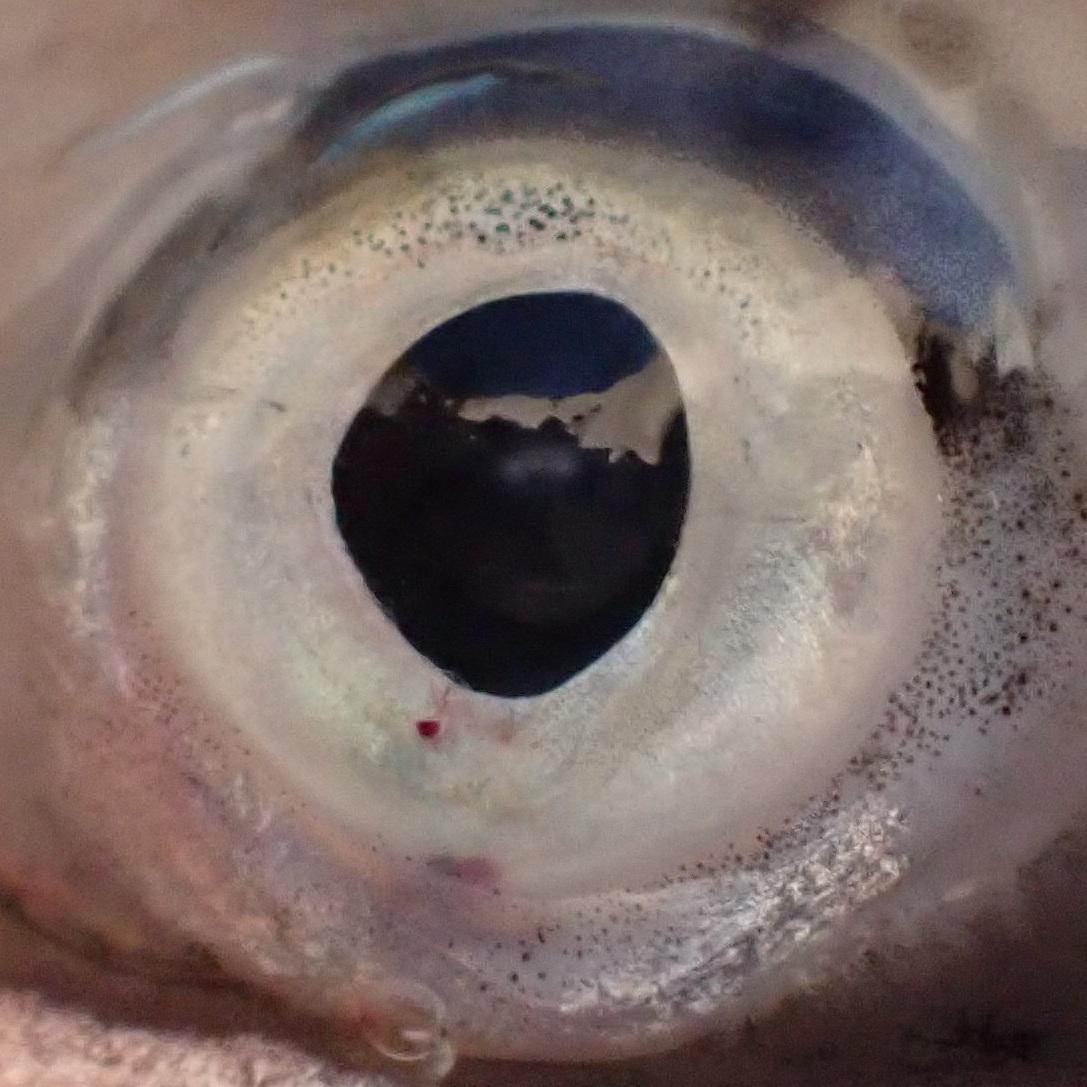
Rainbow trout with minor eye injury54
|
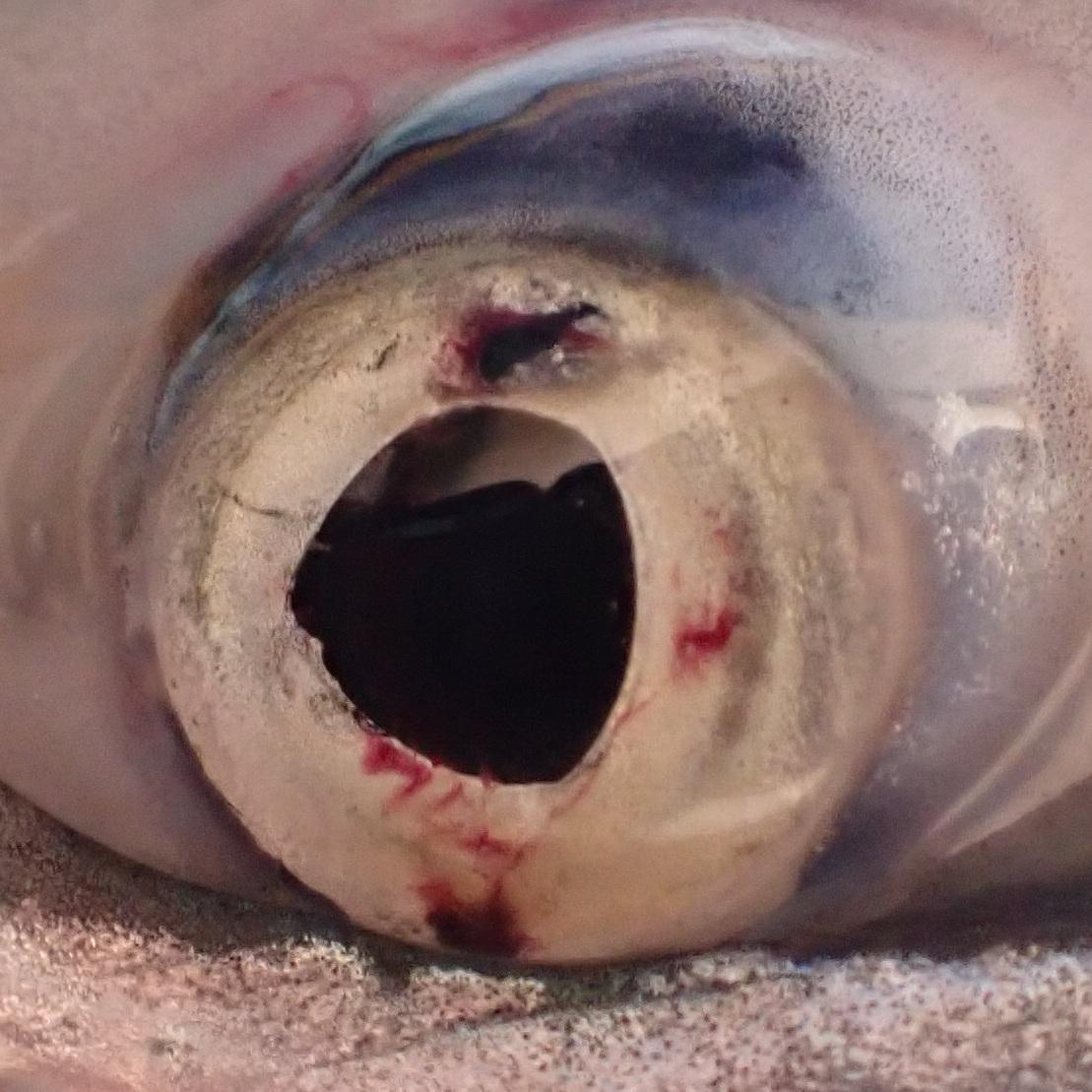
Rainbow trout with clear eye injury55
|
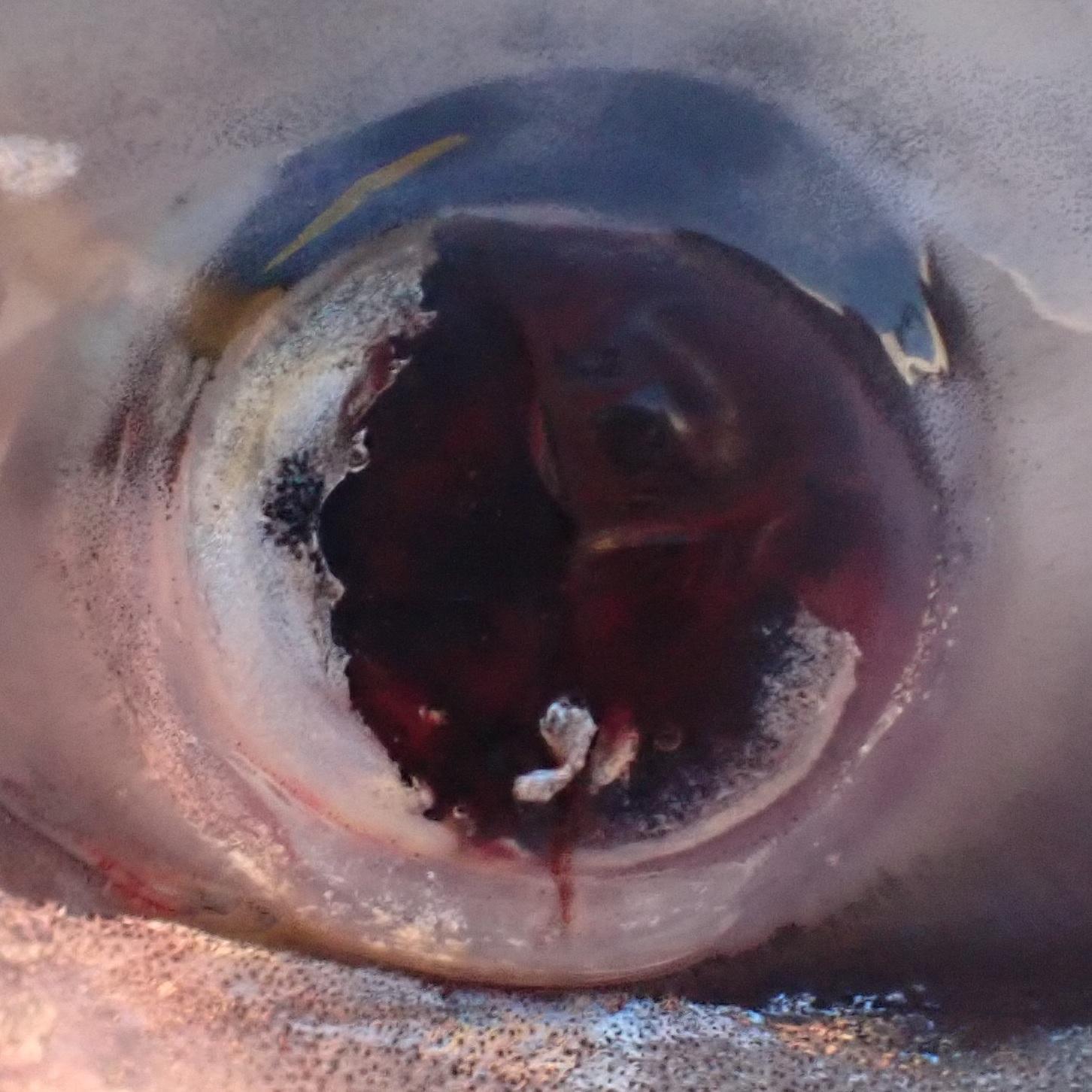
Rainbow trout with severe eye injury56
|
Protocol application
Assessment requires handling the fish for close visual inspection. Injury and parasite presence cannot be reliably assessed in-water.
Score based on the most affected eye, though recording both eyes is recommended to improve data quality.
Calculate the distribution of scores across the thresholds within the sample.
Scoring notes
- Minor eye injuries (level 1) include minor hemorrhaging (e.g., small area at the lower edge of the eye) and minor protrusion.
- Clear eye injuries (level 2) include clear hemorrhaging covering a larger part of the eye and/or clear protrusion.
- Severe eye injuries (level 3) include severe hemorrhaging, severe protrusion, punctured eyes, visible parasites, and gas bubbles. A fish scoring level 3 is expected to have a high likelihood of being blind in that eye.
- Bilateral cases: Where both eyes are scored as level 2 or level 3, the welfare risk is significantly higher than for unilateral cases. If observed, increase monitoring frequency and implement corrective action.
- Validation: This scoring system has been adapted from the Laksvel scoring system for Atlantic salmon.
Key evidence
| Source | Summary of source | Key result |
|---|---|---|
| Pushchina et al., 2020 | Experimental study investigating the effects of mechanical eye injury on brain gene expression in 70 rainbow trout (370–455 g) in freshwater laboratory conditions. Injury was caused by a sterile needle, and fish were monitored for one week post-injury. |
Fish experienced a 1.7-fold increase in cystathionine β-synthase concentration. The injury prompted the formation of specialized repair zones in the brain that were absent in the control. These phenomena were observed 1 week after eye injury, demonstrating an ongoing major response to significant stress. |
| Noble et al., 2020 | Literature review covering a wide range of rainbow trout welfare indicators, including eye injury. | Visible eye conditions were associated with significant welfare concerns, with mechanical injuries being the most common cause of damage. Eye damage progresses from minor conditions to severe welfare impacts, including blindness, pain, and mortality. |
Supporting evidence
- Karami, Asma M., Yajiao Duan, Per W. Kania, and Kurt Buchmann. 2022. “Responses towards Eyefluke (Diplostomum Pseudospathaceum) in Different Genetic Lineages of Rainbow Trout.” PLOS ONE 17 (10): e0276895–95. https://doi.org/10.1371/journal.pone.0276895.
- Karvonen, A., O. Seppälä, and E. T. Valtonen. 2004. “Eye Fluke-Induced Cataract Formation in Fish: Quantitative Analysis Using an Ophthalmological Microscope.” Parasitology 129 (4): 473–78. https://doi.org/10.1017/s0031182004006006.
- Nilsson, Jonatan, Kristine Gismervik, Kristoffer Vale Nielsen, Martin Haugsmo Iversen, Chris Noble, Jelena Kolarevic, Hilde Frotjold, et al. 2025. “Laksvel — a Standardised, Operational Welfare Monitoring Protocol for Atlantic Salmon Held in Sea Cages.” Institute of Marine Research. https://www.hi.no/en/hi/nettrapporter/rapport-fra-havforskningen-en-2025-40.
- Noble, C., K. Gismervik, M. H. Iversen, J. Kolarevic, J. Nilsson, L. H. Stien, and J. F. Turnbull. 2020. “Welfare Indicators for Farmed Rainbow Trout: Tools for Assessing Fish Welfare.” Nofima. https://nofima.no/wp-content/uploads/2020/05/Welfare-Indicators-for-farmed-rainbow-trout-Noble-et-al.-2020.pdf.
- Noble, Chris, Hernán A. Cañon Jones, Børge Damsgård, Matthew J. Flood, Kjell Ø. Midling, Ana Roque, Bjørn-Steinar Sæther, and Stephanie Yue Cottee. “Injuries and Deformities in Fish: Their Potential Impacts upon Aquacultural Production and Welfare.” Fish Physiology and Biochemistry 38, no. 1 (September 15, 2011): 61–83. https://doi.org/10.1007/s10695-011-9557-1.
- Oh, Woo Taek, Jin Woo Jun, Sib Sankar Giri, Saekil Yun, Hyoun Joong Kim, Sang Guen Kim, Sang Wha Kim, Se Jin Han, Jun Kwon, and Se Chang Park. 2019. “Staphylococcus Xylosus Infection in Rainbow Trout (Oncorhynchus mykiss) as a Primary Pathogenic Cause of Eye Protrusion and Mortality.” Microorganisms 7 (9): 330. https://doi.org/10.3390/microorganisms7090330.
- Pushchina, Evgeniya V., Anatoly A. Varaksin, Dmitry K. Obukhov, and Igor M. Prudnikov. 2020. “GFAP Expression in the Optic Nerve and Increased H2S Generation in the Integration Centers of the Rainbow Trout (Oncorhynchus mykiss) Brain after Unilateral Eye Injury.” Neural Regeneration Research 15 (10): 1867–67. https://doi.org/10.4103/1673-5374.280320.
- Thatcher, T. O. 1979. “A Morphological Defect in Shiner Perch Resulting from Chronic Exposure to Chlorinated Sea Water.” Bulletin of Environmental Contamination and Toxicology 21 (1): 433–38. https://doi.org/10.1007/bf01685449.
- Weirup, Lina. “Development of a Fish Welfare Evaluation Index for Rainbow Trout (Oncorhynchus mykiss) in Aquaculture.” PhD Thesis, 2022. https://d-nb.info/1262308445/34.
-
Nilsson, Jonatan. 2026. Healthy rainbow trout eye, score 0. Photograph. Personal communication, Institute of Marine Research.
-
Nilsson, Jonatan. 2026. Rainbow trout with minor eye injury, score 1. Photograph. Personal communication, Institute of Marine Research.
-
Nilsson, Jonatan. 2026. Rainbow trout with clear eye injury, score 2. Photograph. Personal communication, Institute of Marine Research.
-
Nilsson, Jonatan. 2026. Rainbow trout with severe eye injury, score 3. Photograph. Personal communication, Institute of Marine Research.