
Operculum damage
The operculum (gill cover) protects the gills and maintains efficient water flow for respiration. Operculum damage or shortening can result from developmental factors, aggressive interactions (e.g., nipping), handling events, or contact with equipment. When the operculum is shortened or damaged, gill filaments become exposed to physical injury, pathogens, and debris, increasing the risk of secondary infections. Operculum damage can also reduce a fish’s capacity to pump water over the gills, compromising oxygen uptake and leading to respiratory stress.
| Level 0 | Level 1 | Level 2 | Level 3 |
|---|---|---|---|
|
The operculum fully covers the gills |
Minor shortening with limited gill tissue visible (< 10%) |
Clear shortening with some gill tissue visible (10–50%) |
Severe shortening, with gill tissue clearly visible (≥ 50%) |
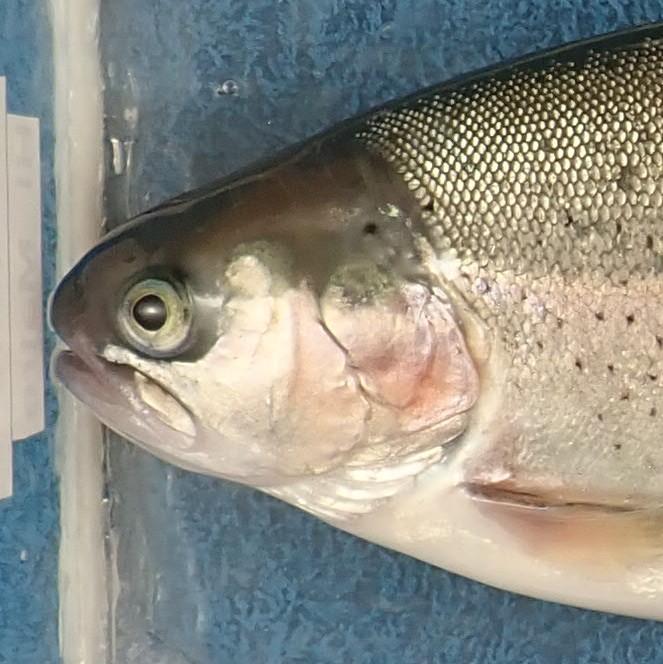
Rainbow trout with no operculum damage57
|
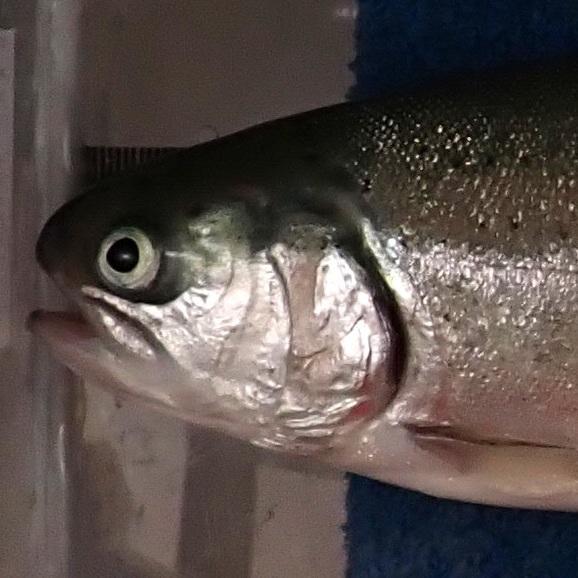
Rainbow trout with minor operculum shortening58
|
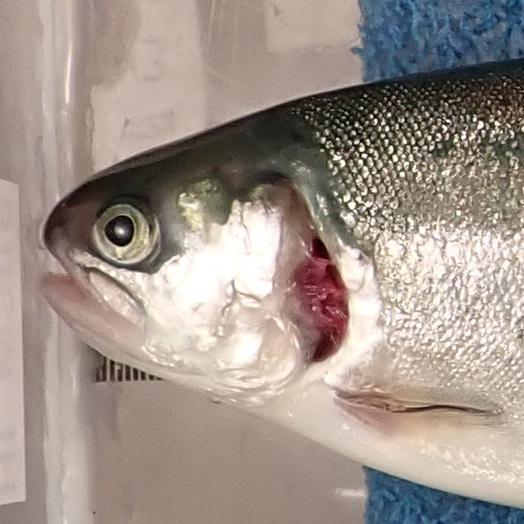
Rainbow trout with clear operculum shortening59
|
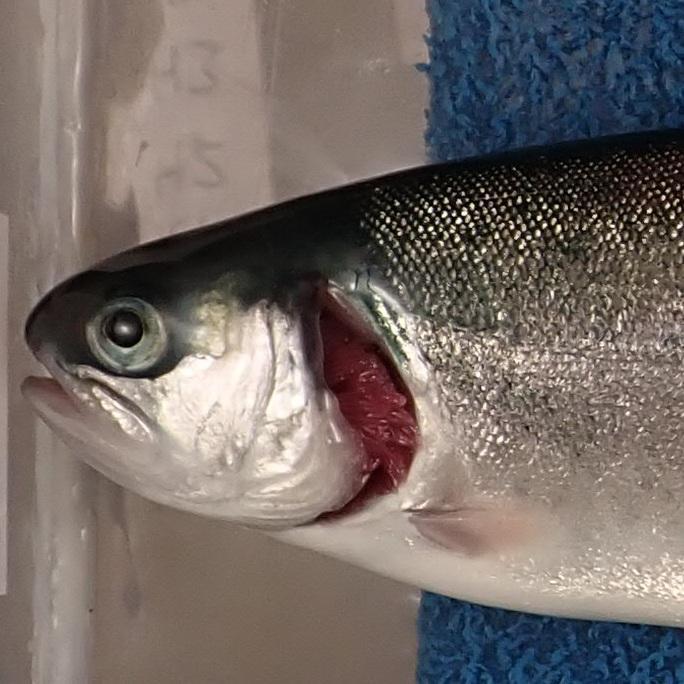
Rainbow trout with severe operculum shortening60
|
Protocol application
Assessment requires handling the fish. The operculum must be observed when fully closed to estimate the percentage of gill tissue visible.
Score based on the most affected operculum, though recording both opercula is recommended to improve data quality.
Where opercular shortening is present, gills must be examined (see the following section on gill damage).
Calculate the distribution of scores across the thresholds within the sample.
Scoring notes
- The operculum should be assessed when fully closed by estimating the percentage of gill tissue visible. This is important for consistent scoring.
- A folded operculum refers to the operculum being abnormally pressed, deformed, or collapsed against the fish’s head, rather than lying flat and being able to move normally.
- Bilateral cases: Where both opercula are scored as level 2 or level 3, the welfare risk is significantly higher than for unilateral cases. If observed, increase monitoring frequency and implement corrective action.
- Validation: This scoring system has been adapted from the Laksvel scoring system for Atlantic salmon.
Key evidence
| Source | Summary of source | Key result |
|---|---|---|
| Peters et al., 1984 | Cross-sectional survey investigating environment-induced gill disease in 160 rainbow trout (58–405 g) from 8 German freshwater farms after at least 3 months on-site. Opercular shortening was classified as “slight” (< 30%) or “severe” (> 30%). |
“Slight” operculum shortening occurred in all fish samples. Prevalence of any gill shortening ranged from ~15% to 80%. Only 3 of the 8 farms had any “severe” cases of operculum shortening. |
| Noble et al., 2020 | Literature review on a number of rainbow trout welfare indicators, including opercular damage. | Damage to the opercula is associated with increased mortality rates and susceptibility to diseases. The authors note damage or deformities of the opercula can occur for many potential reasons, including suboptimal rearing conditions, dietary deficiencies, pollution, and traumatic injuries during competitive feeding. |
| Blaker and Ellis, 2022 | Experimental study investigating the prevalence of opercular shortening on one cohort of Atlantic salmon (growing from < 1 g to ~300 g) in laboratory conditions over 14 months. Over the 14 months, there were 12 sampling instances, with at least 30 fish sampled each time. Fish were initially reared in freshwater, then transferred to seawater after smoltification. |
Opercular shortening was first recorded at the parr stage and increased in both prevalence and severity as fish grew. Short opercula were qualitatively associated with gill filament damage, with the extent of gill damage related to the area of operculum missing. Nipping was assessed as the primary cause of short opercula in the experiment. |
Supporting evidence
- Blaker, E., and T. Ellis. “Assessment, Causes and Consequences of Short Opercula in Laboratory-reared Atlantic Salmon (Salmo salar).” Animal Welfare 31, no. 1 (February 1, 2022): 79–89. https://doi.org/10.7120/09627286.31.1.007.
- Burnley, T. A., H. Stryhn, H. J. Burnley, and K. L. Hammell. “Randomized Clinical Field Trial of a Bacterial Kidney Disease Vaccine in Atlantic Salmon, Salmo salar L.” Journal of Fish Diseases 33, no. 7 (March 28, 2010): 545–57. https://doi.org/10.1111/j.1365-2761.2010.01151.x.
- Eriksen, M. S., Å. Espmark, B. O. Braastad, R. Salte, and M. Bakken. “Long-Term Effects of Maternal Cortisol Exposure and Mild Hyperthermia during Embryogeny on Survival, Growth and Morphological Anomalies in Farmed Atlantic Salmon Salmo salar Offspring.” Journal of Fish Biology 70, no. 2 (February 1, 2007): 462–73. https://doi.org/10.1111/j.1095-8649.2007.01317.x.
- Nilsson, Jonatan, Kristine Gismervik, Kristoffer Vale Nielsen, Martin Haugsmo Iversen, Chris Noble, Jelena Kolarevic, Hilde Frotjold, et al. 2025. “Laksvel — a Standardised, Operational Welfare Monitoring Protocol for Atlantic Salmon Held in Sea Cages.” Institute of Marine Research. https://www.hi.no/en/hi/nettrapporter/rapport-fra-havforskningen-en-2025-40.
- Noble, C., K. Gismervik, M. H. Iversen, J. Kolarevic, J. Nilsson, L. H. Stien, and J. F. Turnbull. 2020. “Welfare Indicators for Farmed Rainbow Trout: Tools for Assessing Fish Welfare.” Nofima. https://nofima.no/wp-content/uploads/2020/05/Welfare-Indicators-for-farmed-rainbow-trout-Noble-et-al.-2020.pdf.
- Pettersen, Jostein M., Marc B.M. Bracke, Paul J. Midtlyng, Ole Folkedal, Lars H. Stien, Håvard Steffenak, and Tore S. Kristiansen. “Salmon Welfare Index Model 2.0: An Extended Model for Overall Welfare Assessment of Caged Atlantic Salmon, Based on a Review of Selected Welfare Indicators and Intended for Fish Health Professionals.” Reviews in Aquaculture 6, no. 3 (June 30, 2013): 162–79. https://doi.org/10.1111/raq.12039.
- Weirup, Lina. “Development of a Fish Welfare Evaluation Index for Rainbow Trout (Oncorhynchus mykiss) in Aquaculture.” PhD Thesis, 2022. https://d-nb.info/1262308445/34.
-
Nilsson, Jonatan. 2026. Rainbow trout without operculum damage, score 0. Photograph. Personal communication, Institute of Marine Research.
-
Nilsson, Jonatan. 2026. Rainbow trout with minor operculum shortening, score 1. Photograph. Personal communication, Institute of Marine Research.
-
Nilsson, Jonatan. 2026. Rainbow trout with clear operculum shortening, score 2. Photograph. Personal communication, Institute of Marine Research.
-
Nilsson, Jonatan. 2026. Rainbow trout with severe operculum shortening, score 3. Photograph. Personal communication, Institute of Marine Research.