
Gill damage
Gills are vital organs responsible for oxygen uptake, carbon dioxide release, and osmoregulation, making them essential for fish survival and performance. Because gills are in continuous contact with surrounding water, they are highly vulnerable to irritants, pathogens, and poor environmental conditions, and serve as an early indicator of suboptimal water quality or disease. Damage to gill tissue can reduce respiratory efficiency and impair the fish’s ability to maintain ion and acid–base balance, leading to stress and compromised welfare.
| Level 0 | Level 1 | Level 2 | Level 3 |
|---|---|---|---|
|
Healthy red gills with no visible alteration |
Minor alterations (affecting < 10% of gill area) |
Clear alterations (affecting 10–50% of gill area) |
Severe alterations (affecting ≥ 50% of gill area) |
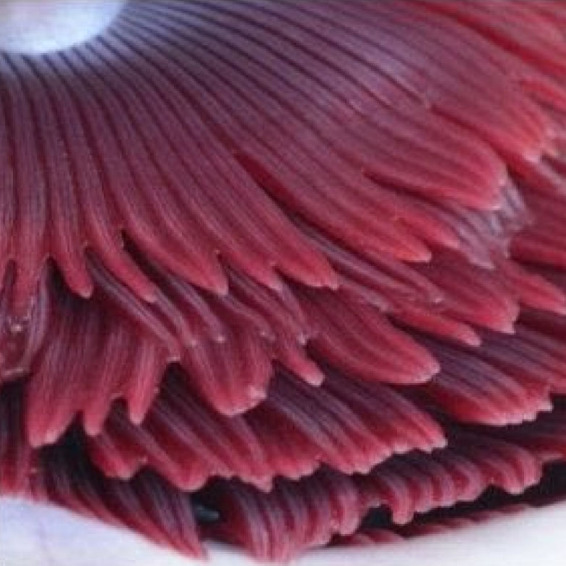
Healthy Atlantic salmon gills61
|
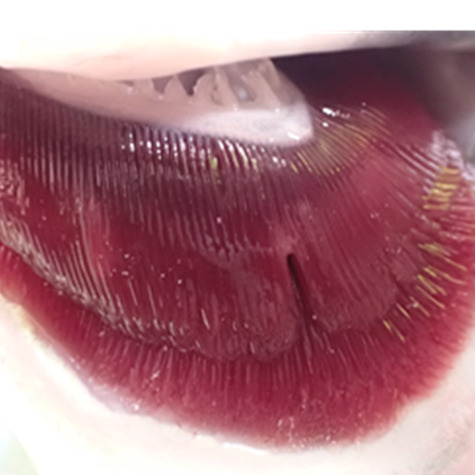
Atlantic salmon gills with minor alterations62
|
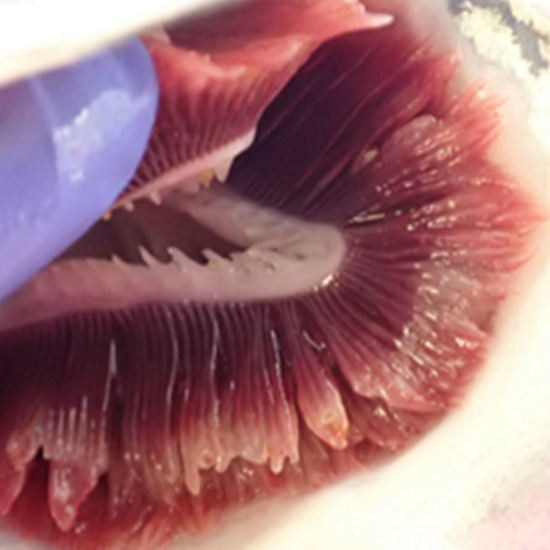
Atlantic salmon gills with clear alterations63
|
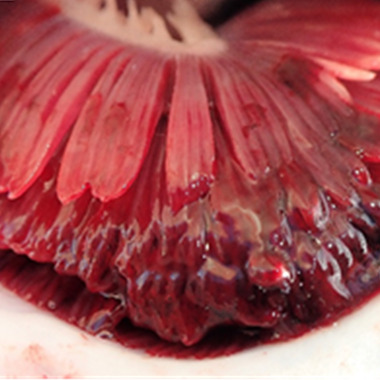
Atlantic salmon gills with severe alterations64
|
Protocol application
Score based on the most affected gill, though recording both gills is recommended to improve data quality.
Gill assessment requires direct handling to lift the operculum for visual inspection and cannot be completed with a camera.
Where gill damage is present, opercula must also be examined (see the previous operculum damage section).
Calculate the distribution of scores across the thresholds within the sample.
Scoring notes
- Alterations include structural changes, color changes (pale areas, discoloration), mucus patches, hemorrhaging, and necrosis.
- For assessors familiar with 5-level clinical gill scoring systems (e.g., Tassal’s gill score guide for amoebic gill disease),21 the approximate mapping is: score 0 = level 0, scores 1–2 = level 1, scores 3–4 = level 2, score 5 = level 3.
- A combination of gill damage and a shortened or folded operculum signals a problem requiring urgent intervention.
- Gill hyperplasia can cause overgrown gill tissue to extend beyond the operculum. This may resemble operculum shortening, but it is a distinct condition and it does not mean the operculum itself is damaged or shortened. Assessors should closely inspect the operculum edge when scoring to determine whether the operculum is normal but the gill tissue is protruding, or that the operculum is truly shortened or damaged.
- Bilateral cases: Where both gills are scored as level 2 or level 3, the welfare risk is significantly higher than for unilateral cases. If observed, increase monitoring frequency and implement corrective action.
- Validation: This scoring system has been adapted from the Laksvel scoring system for Atlantic salmon.
Key evidence
| Source | Summary of source | Key result |
|---|---|---|
| Strzyżewska-Worotyńska et al., 2017 | Cross-sectional study investigating the environmental impacts on gills of ongrowing rainbow trout (500–850 g) in 6 different commercial freshwater farms (3 flow-through systems and 3 RAS systems) in either spring or autumn. In each season, 6 fish were sampled per farm, resulting in a total of 72 trout. Gills were classified as stage I (mild, reversible changes that did not impair function), stage II (intermediate lesions with functional impact), and stage III (terminal lesions with irreversible organ damage). |
Most sampled fish had normal gills. When lesions were present, they were mostly mild and/or reversible. Stage I consisted mainly of epithelial lifting and mild hyperplasia. However, the authors considered that pronounced epithelial hyperplasia with clear lamella fusion impacted function. Stage I lesions made up 73–79% of all lesions. Stage II included telangiectasia, aneurysms, and hemorrhages in the gills, which were larger and more numerous in the fish sampled from RAS systems. These intermediate lesions accounted for about 10% of the lesions. Stage III included fibrosis and necrosis. These damages made up to 7% of all lesions and were about 5 times more common in RAS systems. |
| Zhan et al., 2022 | Experimental study investigating alterations to the mucosal immune system in response to infectious hematopoietic necrosis virus (IHNV) in juvenile rainbow trout (5.66 g) in freshwater laboratory conditions over 30 days. | Fish infected with the virus showed pale gills. Within 10 days, mortality reached approximately 30%. |
| Noble et al., 2020 | Literature review covering a wide range of rainbow trout welfare indicators, including gill damage. | Gill damage can make fish more susceptible to low oxygen levels, stress, or exercise. In freshwater systems, poor water quality can make the gills vulnerable to parasites. In seawater systems, gill disease can result in high morbidity and mortality. |
Supporting evidence
- Clinton, Morag, Elżbieta Król, Dagoberto Sepúlveda, Nikolaj R. Andersen, Andrew S. Brierley, David E. K. Ferrier, Per Juel Hansen, Niels Lorenzen, and Samuel A. M. Martin. “Gill Transcriptomic Responses to Toxin-Producing Alga Prymnesium Parvum in Rainbow Trout.” Frontiers in Immunology 12 (December 8, 2021). https://doi.org/10.3389/fimmu.2021.794593.
- Eriksen, M. S., Å. Espmark, B. O. Braastad, R. Salte, and M. Bakken. “Long-Term Effects of Maternal Cortisol Exposure and Mild Hyperthermia during Embryogeny on Survival, Growth and Morphological Anomalies in Farmed Atlantic Salmon Salmo salar Offspring.” Journal of Fish Biology 70, no. 2 (February 1, 2007): 462–73. https://doi.org/10.1111/j.1095-8649.2007.01317.x.
- Gesto, Manuel, Juan Hernández, Marcos A. López-Patiño, José L. Soengas, and Jesús M. Míguez. “Is Gill Cortisol Concentration a Good Acute Stress Indicator in Fish? A Study in Rainbow Trout and Zebrafish.” Comparative Biochemistry and Physiology Part A: Molecular & Integrative Physiology 188 (October 1, 2015): 65–69. https://doi.org/10.1016/j.cbpa.2015.06.020.
- Hvas, Malthe, Egil Karlsbakk, Stig Mæhle, Daniel William Wright, and Frode Oppedal. “The Gill Parasite Paramoeba Perurans Compromises Aerobic Scope, Swimming Capacity and Ion Balance in Atlantic Salmon.” Conservation Physiology 5, no. 1 (2017). https://doi.org/10.1093/conphys/cox066.
- Lahnsteiner, Elias, Nooshin Zamannejad, Anna Dünser, and Franz Lahnsteiner. “Morphometric and Enzymatic Changes in Gills of Rainbow Trout after Exposure to Suboptimal Low Temperature.” Current Issues in Molecular Biology 47, no. 6 (June 13, 2025): 457–57. https://doi.org/10.3390/cimb47060457.
- Mathiessen, H., M. H. Marana, R. Korbut, B. Wu, A. Al-Jubury, A. M. Karami, P. W. Kania, and K. Buchmann. “Inflammatory Reactions in Rainbow Trout Fins and Gills Exposed to Biocides.” Diseases of Aquatic Organisms 146 (August 26, 2021): 9–21. https://doi.org/10.3354/dao03617.
- Munday, B. L., C. K. Foster, F. R. Roubal, and R. J. G. Lester. “Paramoebic Gill Infection and Associated Pathology of Atlantic Salmon, Salmo salar and Rainbow Trout, Salmo Gairdneri in Tasmania.” In Pathology in Marine Science. Proceedings of the Third International Colloquium on Pathology in Marine Aquaculture, 1990.
- Nilsson, Jonatan, Kristine Gismervik, Kristoffer Vale Nielsen, Martin Haugsmo Iversen, Chris Noble, Jelena Kolarevic, Hilde Frotjold, et al. 2025. “Laksvel — a Standardised, Operational Welfare Monitoring Protocol for Atlantic Salmon Held in Sea Cages.” Institute of Marine Research. https://www.hi.no/en/hi/nettrapporter/rapport-fra-havforskningen-en-2025-40.
- Noble, C., K. Gismervik, M. H. Iversen, J. Kolarevic, J. Nilsson, L. H. Stien, and J. F. Turnbull. 2020. “Welfare Indicators for Farmed Rainbow Trout: Tools for Assessing Fish Welfare.” Nofima. https://nofima.no/wp-content/uploads/2020/05/Welfare-Indicators-for-farmed-rainbow-trout-Noble-et-al.-2020.pdf.
- Peters, Gabriele, R. Hoffmann, and H. Klinger. “Environment-Induced Gill Disease of Cultured Rainbow Trout (Salmo Gairdneri).” Aquaculture 38, no. 2 (May 1984): 105–26. https://doi.org/10.1016/0044-8486(84)90223-0.
- Pettersen, Jostein M., Marc B.M. Bracke, Paul J. Midtlyng, Ole Folkedal, Lars H. Stien, Håvard Steffenak, and Tore S. Kristiansen. “Salmon Welfare Index Model 2.0: An Extended Model for Overall Welfare Assessment of Caged Atlantic Salmon, Based on a Review of Selected Welfare Indicators and Intended for Fish Health Professionals.” Reviews in Aquaculture 6, no. 3 (June 30, 2013): 162–79. https://doi.org/10.1111/raq.12039.
- Strzyżewska-Worotyńska, Emilia, Józef Szarek, Izabella Babińska, and Dominika Gulda. “Gills as Morphological Biomarkers in Extensive and Intensive Rainbow Trout (Oncorhynchus mykiss, Walbaum 1792) Production Technologies.” Environmental Monitoring and Assessment 189, no. 12 (2017): 611. https://doi.org/10.1007/s10661-017-6278-7.
- Taylor, Richard S., Warren J. Muller, Mathew T. Cook, Peter D. Kube, and Nicholas G. Elliott. “Gill Observations in Atlantic Salmon (Salmo Salar, L.) during Repeated Amoebic Gill Disease (AGD) Field Exposure and Survival Challenge.” Aquaculture 290, no. 1-2 (May 2009): 1–8. https://doi.org/10.1016/j.aquaculture.2009.01.030.
- Taylor, Richard, Christine Huynh, David Cameron, Brad Evans, Mathew Cook, and Gordon Ritchie. “Gill Score Guide Amoebic Gill Disease (AGD) Management Training Document.” Tassal Pty, 2016. https://research.csiro.au/aquaculture/wp-content/uploads/sites/217/2018/03/Download-pdf-version.pdf.
- Weirup, Lina. “Development of a Fish Welfare Evaluation Index for Rainbow Trout (Oncorhynchus mykiss) in Aquaculture.” PhD Thesis, 2022. https://d-nb.info/1262308445/34.
- Zhan, Mengting, Zhenyu Huang, Gaofeng Cheng, Yongyao Yu, Jianguo Su, and Zhen Xu. “Alterations of the Mucosal Immune Response and Microbial Community of the Skin upon Viral Infection in Rainbow Trout (Oncorhynchus mykiss).” International Journal of Molecular Sciences 23, no. 22 (November 14, 2022): 14037–37. https://doi.org/10.3390/ijms232214037.
-
Taylor, Richard, Christine Huynh, David Cameron, Brad Evans, Mathew Cook, and Gordon Ritchie. “Gill Score Guide Amoebic Gill Disease (AGD) Management Training Document.” Tassal Pty, 2016. https://research.csiro.au/aquaculture/wp-content/uploads/sites/217/2018/03/Download-pdf-version.pdf.
-
Fridman, Sophie, Smaragda Tsairidou, Nilantha Jayasuriya, Halina Sobolewska, Alastair Hamilton, Carlos Lobos, Ross D. Houston, Hamish Rodger, James Bron, and Tharangani Herath. “Assessment of Marine Gill Disease in Farmed Atlantic Salmon (Salmo salar) in Chile Using a Novel Total Gross Gill Scoring System: A Case Study.” Microorganisms 9, no. 12 (December 16, 2021): 2605. https://doi.org/10.3390/microorganisms9122605.
-
Nilsson, Jonatan, Kristine Gismervik, Kristoffer Vale Nielsen, Martin Haugsmo Iversen, Chris Noble, Jelena Kolarevic, Hilde Frotjold, et al. 2025. “Laksvel — a Standardised, Operational Welfare Monitoring Protocol for Atlantic Salmon Held in Sea Cages.” Institute of Marine Research. https://www.hi.no/en/hi/nettrapporter/rapport-fra-havforskningen-en-2025-40.